Labels

Showing posts with label Self-realization. Show all posts

Saturday, 4 February 2017

END OF SUFFERING - FOR ALL TIMES, FOR EVERYONE

SELF-KNOWLEDGE FROM ANCIENT INDIAN WISDOM

Key topics: Self, Consciousness, Karma, Vedas, Upanishads, Meditation, Brahman, Knowledge, Wisdom, Moksha, Karma, Samskaras


When Gautam Buddha was asked what is really nirvana (liberation), instead of listing out qualities at the risk of missing out some in all probabilities, he merely uttered thus: END OF SUFFERING. Although Buddha had immense knowledge on the subject of liberation, he used wisdom to give an apt answer. Supreme intelligence!


Know that by which all else is known – Upanishad

Yama tells Nachiketa:

Consider the body to be the chariot

And the Self – the master of the chariot

Consider the intellect as the charioteer

And mind – the reins

Sense organs are the horses

And pleasures – their path.

Sense objects are superior to sense organs

Mind is superior to objects

Intellect is superior to mind and..

… Self is superior to the intellect

 
THE ONE WHO KNOWS THIS SELF GOES BEYOND DEATH.


The 3 realities of the Self:

Ø  Apparent (dream) – The experience of existence in dream state.

Ø  Transactional – The experience of existence in the conduct of daily affairs after waking up.

Ø  Absolute – the I AM knowledge that exists constantly from life to death as the fundamental state of consciousness.

Apparent and transactional realities are subject to change but not absolute reality. That is to say, a thief in his dream may be a king; in the conduct of daily affairs may be a father, a debtor or a rebel; but in all situations, his fundamental I AM consciousness remains unchanged from birth to death.

The 4 obstacles on the path of meditation:

1)      Nidra (Sleep)

2)      Vikshepa (wandering of the mind)

3)      Kashaaya (neither total sleep nor total wandering of the mind, but a balance. There is still the seed of vaasana (desire) that has not yet ended).

4)      Rasasvaada – when one starts enjoying the state of meditation and is unable to move ahead.

Mahavaakya – The ultimate statements of wisdom / proclamation from Vedas:

Each of the 4 vedas contains one such declaration that represents the essence of ultimate experiential wisdom; hence 4 mahavaakya:

Pragnyanam Brahma:

Ø  It is a Lakshana Vaakya as it indicates the characteristics of the Supreme as consciousness.

Ø  From Aitreya Upanishad of Rig Veda.

Ø  This is what some philosophers would state as ALL FORMS OF KNOWLEDGE POINTS TO SELF-KNOWLEDGE.


Aham Brahmasami:

Ø  It is classified as Anubhava Vaakya because it reveals YOUR experience of being one with Brahman.

Ø  From Brihadaranyaka Upanishad of Yajur veda.

Ø  This is what philosophers refer to as I AM BRAHMAN – everything past/ present/ future – manifestation and pure potential.


Tat Tvam Asi:

Ø  It is categorised as Upadesha Vaakya because a Guru bestows this grace of wisdom upon the disciple.

Ø  From Chandogya Upanishad of Sama veda.

Ø  This is what great masters state; merely pointing out for self-exploration – THAT YOU ARE.


Ayam Atma Brahma:

Ø  It is referred to as Anusandhaan Vaakya because a seeker has to keep researching and investigating through it.

Ø  From Mandukya Upanishad of Atharva veda.

Ø  SELF = COLLECTIVE SELF / INDIVIDUAL CONSCIOUSNESS = COLLECTIVE CONSCIOUSNESS.

The journey of self-discovery is taken via two routes that often merge and diverge:

1)      Inductive method: By gaining knowledge through facts- Take guidance from scriptures and teachers on established truth; KNOW ALL TO KNOW THE ULTIMATE.

2)      Deductive method: By using wisdom to subtract ignorance – The maxim of Neti-Neti (Not this-Not this) – start from where you are and negate all that you are not to reveal what your ultimate self is. Discover the noumenon to understand the phenomenon. As Socrates stated, ‘Know yourself and you shall know the world.’ FROM THE ULTIMATE - KNOW ALL ELSE.’

 
In the apt words of Capt. Ajit Vadakayil, “Knowledge comes from learning. Wisdom comes from living with consciousness – the five senses are used to observe. Wisdom is gleaned and filtered. In knowledge you learn something every day, while in wisdom you unlearn something every day (in modern computer parlance: delete / format). Yet, wisdom grows while knowledge shrinks... with knowledge you can make a living, with wisdom you get a life – deep happiness. Wisdom has perfect timing unlike knowledge – like gleaning a fogged up and dirty car windscreen during night driving. Knowledge minus ego = wisdom.”

A seeker thus delves upon:

A] Find out WHO AM I? AND HOW DID I MANIFEST?

B] HOW DO I GO BACK WITHOUT ANYTHING COMPELLING MY RETURN EVER AGAIN? (MOKSHA)

To know [A], the I AM consciousness comes into being with the formation of body and birth. It is the first sensory experience we all have. How does form manifest as mentioned in the vedas?

“The unified existence as the ultimate truth without duality desired to become many… from ether/space originated air; from air was created fire; from fire came water and from water came earth” – the five elements that constitute creation of life from subtle element to gross element as we know.

To know [B], the process of dissolution or death involves perceiving the above in reverse (gross to subtle): the last breath exhaled merges with the wind element; body loses heat to the fire element; dehydration sets in to merge moisture from the body with the water element and finally bones and tissues shrivel and merge with the earth. So what about the ether element? It retains all the mental remnants (samskaras) of the once living body… all the thoughts, unfulfilled desires and the individual’s karmic baggage.

 
Quantum physics has revealed that there is no distinction between matter and energy. Visible matter is condensed energy and subtle energy is the scattered version of the same. Energy cannot be created or destroyed but transforms into various forms as we have studied in our schools. Every thought is a subtle energy and the very source it appears from, also is the very source it returns to – ether – and becomes a part of the akashic records. Here, the samskaras propel rebirth for achieving completion. As long as samskaras exist, rebirth is inevitable, thus creating bondage to the seemingly endless cycle of birth and death. Moksha thus is subject to neutralising karmic accounts of every individual.

 Karma:

“All actions performed before enlightenment hold on to the body and the body does not get liberation until they are exhausted.” – Adi Shankaracharya (Vivekachoodamani)

Types of karma:

1)      Sanchita karma (accumulated debt of past lives karma awaiting manifestation)

2)      Prarabhda karma (sanchita karma + present life’s karma balancing out in present life)

3)      Agami karma (unsettled present life karma awaiting balancing out in future birth)

Upon enlightenment (realisation of Brahma through personal experience), sanchita and prarabhda karma get nullified (as attachments of mind) because the individual experiences the fruits of these karmas passively i.e. it becomes an impersonal experience for the realized to undergo the fruits of karma, for he/she remains neutral and unaffected knowing oneself to be neither the doer nor the deed… but simply pure awareness (the original I AM consciousness / Aham Brahmasmi). In the final stage of samadhi, the shift is beyond this pure awareness – Para Brahma!

A crude analogy that comes closest to exemplifying the aforementioned would be that of dream-filled sleep and dreamless sleep. In your dream, you would play out myriad events and experience the emotions thereof, only to wake up and realise that your SELF was the only constant and is the same subject that observes upon waking up too. There is no dream without dreamer and no dreamer without the Self.
 

But when you wake up from a deep dreamless sleep, where was the dreamer? During that sleep your ‘I AM consciousness’ was absent (you didn’t know you existed) but after waking up… you’d definitely realize that something in you was aware all the while that you were sleeping – that consciousness which is infinitely aware – even after you recover from a state of coma. It is a very subtle identity that is beyond ‘I AM consciousness’. What is that?

That infinite field of pure potential without beginning or end, the primordial existence (Shiva) prior to manifestation (Shakti), the nothingness, yet containing everything -> the eternal truth as it always was, always is and always will be… without the experience of time or space… the truly indescribable Before-I-AM !
*****

Thursday, 5 June 2014

THE ETERNAL CONFLICT

Blindly following ethics or responding consciously ?

EXISTENCE: PERFECTION WITHIN IMPERFECTION


Sylvester Stallone hit bulls'eye with the words of wisdom from ROCKY BALBOA, stating: THE WORLD AIN'T ALL SUNSHINE AND RAINBOWS

Taking a cue from the first line itself, one can infer that the world we live in is undoubtedly filled with conflicts of many forms. There is this battle between good and evil, wealth and poverty, health and sickness, peace and war and so on.. not just this world, but the entire cosmos is structured on the principle of duality - for every form has its opposite form somewhere in the fabric of existence and one cannot exist without it's COMPLEMENTARY OPPOSITE other.

Though the topic of duality features in many of my posts in this blogsite, I have been intrigued for some time to express my thoughts on the theme of resistance, delving more into stuff like Competition, Perfection and War.
I am of the opinion that absence of 'competition with the other' results in harmony, absence of 'fanatic perfection' results in bliss and absence of war results undoubtedly in peace.

How could we understand the above statement? What was 'competition' before it became competition? What was 'perfection' before it became perfection? What was 'war' before it became war? No matter what the choice of words be, but the answer boils down some way or the other to harmony, bliss and peace; Right?? Of course, we have spared no effort to invent an opposite word- an antonym for every possible form or quality that we know exists! But the question is, is the principle of duality really true or is it some kind of an illusion that conceals THE TRUTH - THE SOURCE OF EVERYTHING ?

There are ample education sources available to explain and prove that light is not the opposite of darkness, but the absence of light; heat is not the opposite of cold, but the absence of heat (vice-versa) and so on. My question to you is - WOULD YOU CALL A WAVE AN OPPOSITE FORM OF THE VERY OCEAN FROM WHERE IT EMERGES ? Therefore, would you not agree that from the 'Status Quo' comes forth a certain agitation and leads to a series of eruption of forms that give an illusion of one form being opposite from the other? That is to say, before competition there was the state of  'no-competition' or shall we safely say The Absence of DESIRE for competition; before perfection was the state of no-perfection or The Absence of DESIRE for perfection; before war was the state of no-war or The Absence of DESIRE for conflict. Isn't it so ?

One has to be prudent to understand that the use of antonyms is in itself a desire to be separate one from the other. Words like incompetence, imperfection and peace instill in our minds the desire to remain separated - that is if you do not fall under one category, it is to be implied (sic!) that you ought to be in the other (opposite category). Why should one be either THIS or THAT ? The moment the mind thinks of 'peace', that very moment it has swung into desire to resist war. If this is so, then where is that source - the one - before even the idea of peace and war appeared? The same rational approach is applicable when examining 'bliss' and 'harmony'.
Isn't there a neutral state - a stateless state that indicates the source of forms that keep transforming and evolving ? Why do you think the wise Indian sages invented the concept of ZERO?
Check out my post on THE SIGNIFICANCE OF ZERO - RATISH IYER by searching within this blog site where I have written at length on this topic.

I agree with the fact that forms change - But is the REAL YOU to be associated with various forms you undergo? The REAL YOU is the CONSCIOUSNESS upon which all changes flow in your life - from your growing and ageing body, to your relationships, to your ideas and ideals and the perception of the environment in which you exist. No matter the length of passing time - your feeling of  I AM - this consciousness remains the same until you live no more. Advaita and Zen masters preach the technique of Neti-Neti ( Not this-Not this / Not that-Not that) to arrive at knowing WHO YOU REALLY ARE. Just as the wave is no different from the ocean - although it may consider itself to be separate -- is in essence the very water that permeates 'heaven and earth' in its myriad forms.

If you read what has been written up till this point once more, you would see the use of the word DESIRE mentioned in both extremes of forms - like, desire to compete/ desire to Not Compete, desire for war / desire for peace.. what is this desire?? Isn't this very desire the very shrewd factor that makes our minds swing on to THIS and THAT? Is it of any remedial measure to swing from one extreme perception to another? Do we as a result, become ETERNALLY HAPPY? NO! Because it is the very nature of our minds to categorize and perceive! Without this, how would we experience and understand our existence? How can an experience happen without a subject and an object/ objects ? When I know war, I know what peace is, if I experience sickness, I realize what optimum health is; right ? Was I consciously aware of and knowing what peace is - without the event of war? Was I consciously aware of and knowing what it would be to have my health going off-balance/ or knowing what it is to be healthy without first falling sick? Do you recall any point in time when you were truly blissfully unaware of these opposite feelings and experiences? With knowledge and experience comes CONDITIONING and depending on the type of experience, one holds on to what is acceptable and resists what is not - the very idea of THIS and THAT - the very emergence of LOVE and FEAR. But before these two polar forms appear in our lives, we were Blissfully Unaware - a stage of nothingness to say - the stage of ZERO (Neutral) - the original nature of all things. Zen masters have a saying: WHAT IS YOUR ORIGINAL FACE - THE FACE BEFORE YOU WERE BORN ?

So in other words, experiences happen when one form (event) is perceived in relation to its opposite other (form). And as long as this desire to know/experience/create exists, it automatically triggers the existence of its complimentary opposite form. For the layman's understanding, this is where Einstein's theory of relativity comes in where an experience/event is understood on the basis of space-time continuum. And within this structure we form our personality based on our ideas and experiences and with constant conditioning, we look at the world/ the other form/ existence with Love or Fear depending on the intensity of our consciousness. The only difference between an enlightened person and the normal/ ignorant person is that the former knows the truth about Non-Duality - that in essence we are the same. albeit subject to changing forms in order to REMEMBER THROUGH RELATIONSHIPS (based on experiencing duality) AND DISSOLVE BACK TO OUR TRUE SOURCE.  

Coming back to the topic of Perfection/Competition/War - ask yourself: WHO AM I PERFECTING? WHO AM I COMPETING WITH? WHO/ WHAT AM I IN CONFLICT WITH ? When the world and I are no different, what is the fear that is driving me to perfection/competition/war ? Why should I even cling to the notion of peace/harmony/bliss? Where is the original nature of all things before categorization set in ? That state - where there is neither the Love of what is acceptable, nor the Fearful denial of what is not acceptable - should we call it Pure Innocence or Ignorance is Bliss? Should we adulterate that understanding by even naming it? Because the moment it is uttered, it loses its pure identity - such is the Satori! If there is any Zen wisdom that can put the aforementioned attempt to explain, in the most brief and profound manner - it would be this:
 " WHEN YOU SEEK IT YOU CANNOT FIND IT" - Zen riddle

If you are able to be struck with even the slightest flash of understanding from the above, you would realize that we are so heavily conditioned with our ideas and doctrines that we forget that we are truly inseparable from one another - and that means the entire existence of the past/present/future !

In spite of our notion that our lives are imperfect, Existence has perfectly blended perfection within imperfection. Check out the following facts:
A WATER THAT IS PERFECTLY PURE CANNOT BREED FISH

EXTREME LAUGHTER LEADS TO TEARS, EXTREME CRYING APPEARS AS LAUGHTER

SHARPEN A BLADE TO THE EXTREME AND IT IS OF NO USE ANYMORE

ALL WORK AND NO PLAY MAKES JACK A DULL BOY; ALL PLAY AND NO WORK MAKES JACK A  DISASTER- (Self-quoted for humor's sake)

The moment you start associating yourself with one form you are bound to have an antagonistic relationship with the other - After all who doesn't want happiness all the time? But we aren't eternally happy, are we? How does Existence ensure phenomena govern our lives? Boredom, of course! Desire for change comes into action: When static mode sets in, dynamic mode takes over. But dynamism cannot go on forever. There is always the need for balance. The balance is between static energy and dynamic energy. The point of balance is neutrality, where one can perceive it as the beginning or the end of either forms. Neither form dominates the other for one is non-existent without the other. A simple example to consider here would be the rotation of the earth on its axis and the revolution around the sun: indicating why there is day on one side of the globe and night on the other side; why there are seasonal variations on either side of the globe; why vegetation differs across the globe.

Therefore, the desire to have only one side of existence as dominant is utterly futile! Even in the Bhagavad Gita, Lord Krishna explains to Arjuna that there has never been a time nor will there ever be a time when everyone including themselves (Krishna, Pandavas) and their foes (Kauravas) ever was or shall be non-existent - the forms vary but the essence/ soul beyond the dual forms remains infinite. So, for every good there will always be a bad -- for neither can exist without the other.


Thus, the idea of UTOPIA is NOT that everything is only good in such a world, but the truth is that UTOPIA CAN ONLY REFER TO A WORLD WHERE THE OPPOSITE FORMS OF EXISTENCE REMAIN IN BALANCE AND HARMONY.

For those who have watched and enjoyed the movie series of THE MATRIX -


In the final part, the protagonist's (Neo) choice to die at the hands of the antagonist (Agent Smith) comes after Neo having contemplated thoroughly the purpose of his existence and what is required of him to be done. After terminating Neo, the antagonist is left perplexed. He was under the illusion of usurping Neo's energy to become 'the Ultimate', but eventually he ends up being annihilated himself! Why? How? Smith fails to realize what Neo had realized - Being opposite forms of each other, Neo's death meant that his 'opposite other' (Agent Smith) was also required to be pulled out of the equation to reset balance, i.e. the very event had to ensue the programmed execution of the Matrix's rules (nature's law) - the deletion of the opposite! In the end balance sets in, but the audience is left to contemplate as to how long such a status shall prevail...!


What do we learn from Neo ?
1. The Matrix (Nature/Existence) is made up of duality - opposite forms interdependent and complementary to each other. Good and Bad co-exist.

2. Perfection that means only good should remain - is an illusion - as long as we live in this world made up of duality.

3. Imperfection does not mean that 'Bad' is really bad for the system - Where good is bad must be! So it is futile to project the illusion of Utopia where only good should flourish.

4. Our decisions should be focused only on harmony of the dual forms and we must strive to achieve the right balance.

So how do we make an 'ideal' choice or the 'perfect choice' given our limitations? The first step would be to accept the present moment and Existence as it is and acknowledge the validity and harmony of duality. The second step is to transcend duality through conscious awareness. The third step would be to act consciously based on the conscious decision and trusting existence to take care of the consequences - regardless of what the choice entails - balance will always prevail !

THE POINT IS: WILL YOU BE DELUDED THAT THERE IS A DOER, AND CONTINUE RESISTING, OR WILL YOU ACHIEVE THE HIGHEST UNDERSTANDING THAT 'EVENTS HAPPEN, DEEDS ARE DONE, BUT THERE IS NO DOER' AND LET EXISTENCE FLOW TAKING ITS NATURAL COURSE ?

THE CHOICE ON THE PATH OF TRUTH LIES WITH YOU!

****

Saturday, 9 November 2013

Time and Timelessness

Our existence in relation to the concept of Time

The concept of time is a paradox. Time and Timelessness are two sides of the same coin.

When one is time-oriented, if observed carefully, one sees that there is actually no present moment. The NOW does not really exist. How? Let's observe:
There are only past and future as reference points concerning time. The NOW (the present) is the future of the past as well as it also remains the past of the future. The NOW is ever-flowing. For example, if you time yourself to feel and proclaim 'NOW' at the 10th second from the current time - even if you feel and experience the state of NOW, at the exact 10th second, the mili-seconds would have already passed away and the NOW remains a feeling based on experience of the 'Now'. It is like sand slipping away from under your feet at a beach by the action of receding waters. The grains of sand in this scenario can be compared to moments in time.

The present is simply the future waiting to be experienced. Present is borrowed from the future.

On the other hand, timelessness is an experience of ceasing to have all reference points. Rather than engaging the mind on the duality of Past and Future, it is simply freed - just let open. This is what the famous philosopher Krishnamurti termed as 'choiceless awareness'. It is akin to a dam which contains the same water on either sides - imagine one side is called Past and the other side is called Future! Once the mind is opened, the past and the future merge and become one entity - TIMELESSNESS. Yet this timelessness is the very source of the illusion - the separation based concept of TIME. Like the dam, the mind restricts energy (due to splitting existence based on the space-time concept, of which time is divided into past/future/present).

When there is no resistance, energy resumes its natural state of flowing continuously. It is a feeling of being in the NOW but without the time's reference points of past and future. In the peak of that experience of being in the present, the NOW gradually fades away... ultimately unravelling TIMELESSNESS.


THIS TIMELESSNESS IS A NEUTRAL STATE -- BEYOND THE DUALITY OF LOVE AND FEAR, PEACE AND CONFLICT, JOY AND SADNESS. It is only in associating with the illusory concept of TIME that these dualities affect our nature of existence.

*** 
 

Thursday, 14 March 2013

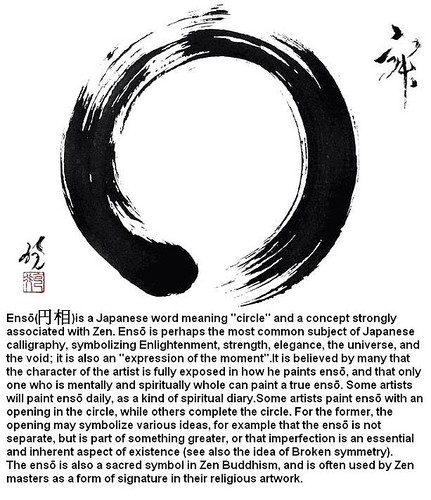
The power and significance of zero/circle in mathematics, martial arts, zen and spirituality


This is no mathematics class, but it is an eye-opener in a simple way for those folks like me who have ever hated/ hate mathematics and are unable to figure out what makes nerds love mathematics.

I used to despise and dread mathematics. I would always feel that the general public would most of the times be under an illusion to measure intelligence by the way you could parrot and vomit tables or arithmetic laws or alegbra equations {x+y the whole square is equal to...blah blah}, or how you could master complex calculations.. the bigger the number the better.. especially the ones with decimal values -the icing on the cake !

It would surprise some of you to know that the greatest teacher of mathematics was Ancient East ( Vedic civilization in the ancient Indian subcontinent) and the greatest student of mathematics was the West - Jesus Christ to be specific. Why do I say this ?

Zero is the greatest contribution to mathematics as we all know. But how could I say Jesus as the greatest student? My opinion may be valid if the following story could be true: Well, I happened to read somewhere if I remember correctly, about a short story on Jesus' childhood - that when he was a student, he asked his teacher to explain what was the meaning of the number 1. The teacher was perplexed by this question and tried to persuade him to proceed with 2. Not convinced, Jesus told the teacher that unless he was made to understand what number 1 meant, he could not proceed to understand anything further.

I have a strong feeling that I had read this in of Osho's discourses, although I cannot recollect precisely where.

The point here is, if it was so, then Jesus was perhaps unconsciously searching for the meaning of zero rather than 1.
Ancient Indian civilization was a highly advanced civilization many ages before the advent of Jesus Christ. This civilization reached the epitome in all spheres of life.

I will try my best to explain in simple language based on my personal understanding, the power and significance of the number zero/ the shape of circle or round:

1. Wisdom is the transcendence of intelligence. Philosophy/Spirituality is the final journey in the quest for knowledge. Even if you wish to travel around the world, it is a circle that takes you to a return trip to your starting point. Similarly, the spiritual significance of zero ('shunya' - in Sanskrit) comes from the wisdom of Ancient sages who through their individual & personal enlightenment came to realize that everything originates from nothingness. That nothingness is the space, the void, the emptiness  - the background on which all manifestations appear and disappear. So a number like 1 has no significance unless it is in relation with another 1( in numeric terms we call it 2); else the primal 1 has no indentity by itself. To represent that source from which everything springs forth and disintegrates to, the idea of zero took birth, the shape of circle being the graphical representation of going back to the source  - the source of non-duality.

2. A circular motion is the most powerful energy configuration, In science, we learn that a soap bubble has the most efficient energy configuration-structure. A mass in an ongoing circular motion builds up tremendous energy, and would be able to deflect any onslaught force. The whole of our cosmos is based on rotation and revolution - our solar system, our bodies energy patterns - the movement of electrons, protons, neutrons..

3. In martial arts (especially Tai Chi and Aikido) and Zen, the idea of circle is the fundamental underlying principle governing the way of the universe. Circular motion in these martial arts, emphasize on the use of accepting the opposing energy and then deflecting the energy often in circular ways. Check a sample of the 'randori' (multiple attackers) in the way of Aikido to get a feel of the way of least effort and resistance. Here comes hollywood actor Steven Seagal in action:


Now, you could dust off the armour of your self-respect henceforth if anybody calls you a A BIG FAT ZERO! Could you imagine the greatest of scientific inventions possible without the invention of wheel? There may be numerous teachers of mathematics, who may not have had even an iota of self-realization about the concept of void and zero. The day you have a direct experience of the profound significance of zero - you shall have gained the essence of mathematics. When I interpreted this way, my respect for mathematics increased, albeit without any additional love (in good humour of course).

On the forthcoming occassion of Easter - Wishing everybody HAPPY EASTER

Thursday, 22 November 2012

Who am I? The ultimate question

from the first chapter of POINTERS FROM NISARGADATTA MAHARAJ - by Ramesh Balsekar

'Know yourself and you know the world' - Socrates

Pride of Achievement

"I have worked hard and I now consider myself a very successful man. I would be a hypocrite
if I did not admit that I have a considerable amount of satisfaction and, yes, a certain amount of
pride too in my achievement. Would that be wrong?"
One evening a foreign visitor addressed Sri Nisargadatta Maharaj with these words. He was in
his mid forties — smug, self-confident and a bit aggressive. Conversation then proceeded along the
following lines:

Maharaj:

Before we consider what is 'right' and what is 'wrong', please tell me who is asking
this question.

Visitor:

(A bit startled) Why, 'me', of course.
M:

And who is that?
V:

Me. This 'me', who is sitting in front of you.
M:

And you think that that is you?
V:

You see me. I see myself. Where is the doubt?
M:

You mean this object that is before me? What is your earliest recollection of this object that
you think you are. Think as far back as you can.

V:

(After a minute or two) The earliest recollection would perhaps be of being caressed and
cuddled by my mother.

M:

You mean, as a tiny infant. Would you say that the successful man of today is the same
helpless infant, or is it someone else?

V:

It is undoubtedly the same
M:

Good. Now, if you think further back, would you agree that this infant, which you can
recollect, is the same baby that was born to your mother, that was once too helpless even to realize
what was happening when its little body was going through its natural physical functions, and could
only cry when it was hungry or in pain?

V:

Yes, I was that baby.
M:

And before the baby acquired its body and was delivered what were you?
V:

I don't understand.
M:

You do understand. Think. What happened in your mother's womb? What was developing
into a body with bones, blood, marrow, muscles etc., over a period of nine months? Was it not a
male sperm cell that combined with ovum in the female womb thus beginning a new life and, in the
process, going through numerous hazards? Who guarded this new life during this period of hazards?
Is it not that very infinitesimally tiny sperm cell which is now so proud of his achievements? And
who asked particularly for
you? Your mother? Your father? Did they particularly want you for a
son? Did you have anything to do with being born to these particular parents?

V:

I am afraid, I really haven't thought along these lines.
M:

Exactly. Do think along these lines. Then perhaps you will have some idea of your true
identity. Thereafter, consider if you could possibly be proud of what you have 'achieved'.

V:

I think, I begin to understand what you are driving at.
M:

If you go deeper into the matter, you will realize that the source of the body—the male
sperm and the female ovum— is in itself the essence of food consumed by the parents; that the
physical form is made of, and fed by, the five elements constituting the food; and also that quite
often the body of one creature does become the food for another creature

V:

But, surely, I, as such, must be something other than this food-body.
M:

Indeed you are, but not some 'thing'. Find out what it is that gives sentience to a sentient
being, that without which you would not even know that you exist, let alone the world outside. And
finally, go deeper yet and examine if this beingness, this consciousness itself is not time-bound.

V:

I shall certainly go into the various questions you have raised, although I must confess that I
have never explored these areas before, and I feel almost giddy in my ignorance of the new spheres
you have opened up before me. I will come

Sunday, 18 November 2012

On conditioned existence

'Neti-Neti' (Not this, Not this)

See the false as false and the truth will be revealed

Peeling the layers of onion one by one

 
'Neti-Neti' is a beautiful phrase in the Sanskrit language that describes enlightened living. There are two perspectives to understand the 'concept' of enlightenment - enlightenment as an event and enlightened living. The former signifies an experience at some point of time wherein a swift flash of understanding strikes. The latter refers to the application of this understanding in daily living, nay, moment to moment living. The former happens once and the latter is an ongoing process.
 
What is enlightenment? Rather, what is the 'concept' of enlightenment? Who seeks enlightenment?
 
When I ponder on the above questions, I am left with the answer to the last question of who seeks enlightenment - I. Isn't is it so ?
 
The first step in the quest for the ultimate answer to all our problems requires that the ultimate question be identified. Therefore, the ultimate question is WHO AM I ?
 
From here starts your journey of true intelligence - because all the while you have been accumulating knowledge. Your perspective has always been towards the external; now you are going reverse. You are to go back to the source and this is only within.
 
There is a zen story about how a zen master was asked to describe enlightenment and he asked the questioner to start peeling an onion layer by layer. What must have the questioner found after peeling peeling the last layer ? This I leave it for you to get your own flash of understanding.
 
The peeling of onion is an analogy to guide you towards peeling all those layers of conditioning that have formed around you as your shell and preventing you from seeing truth as it is. To know what you are you need to identify that which you are not. Once identified, you must be brave and honest to accept your layers of conditioning and let your Self shine through in its natural, original form. Once you know your Self, you know the universe. Once you know the universe and your Self, you will have to cross the last frontier. When this crossing is experienced and understood, you will realize that it cannot be described - but like a finger pointing to the moon, sages have had to coin the word 'enlightenment' as a pointer to THAT which you think you are seeking.
 
The following article from P. Vaidyanathan will guide you on your second step - recognizing that you are conditioned and the need for the conditioning to be expelled. You have already taken the first step by asking: WHO AM I ?
 
ASK YOURSELF HOW FREE YOU ARE - by P V Vaidyanathan
Most of us would say that we do have free will. We can do anything we wish. If we want to wear a red shirt instead of a blue one, we can. If wewant to pizza, we can. If we want to take off from work and sit at home today, we can. If we want to marry the girl or boy we love, we can. If we have enouhg money, we can buy any house, car or gadget. Likewise, we can travel wherever we want to. Obviously, it looks as if free will exists.
According to Ramesh Balsekar, all the choices that we make are from the act of exercisingthe will. How free is free will? Whatever we call free will or choice is finally determined by a mix of two things- nature and nurture, or by our heritage and conditioning. We can't choose our parents, and hence we have no choice over the genetic material they gift to us. Also, from birth, we are exposed to conditioning and belief systems. These are required for survival.
In the process of growing up, we are conditioned and led to believe a great many things by family, friends and strangers, the media, commercials, books and what-have-you. As an adulat, we are thus a mixture of our genetics and all these conditionings. This is our programming; our code. And all our decisions, our choices, our thoughts and acts, originate from this programmed mind. A part of this programming is done by nature and the environment does the rest of it. Really, there is nothing sacred or pure about our decisions.
Is this a good thing or a bad thing? By itself, this is difficult to say. But at least we should realise that what we normally consider freedom or free wil, is itself a slave of a programming.
If you were to ask a vegetarian "Why don't you like meat?", he would most often answer, "Because it is bad to eat meat."
"And how have you come to this decision that eating meat is bad?"
"I have always been told that eating meat is bad and should be avoided."
As one can see, the decision not to eat meat may seem an act of freedom or free will, but the conditionings of childhood are holding us in slavery, unknown to us.
If 2 like-minded friends were asked: "What would you do if you were walking together, and saw one man killing another?"
One of them might reply: "I will immediately go to the victim's rescue, even if it means risking danger to myself", while the other might say, "I will run away, find the nearest telephone booth, and call the police, without identifying myself."
The two friends are close; they often think alike but on this occasion they react differently. This could be because of their basic natures that have been shaped by their respective circumstances and upbringing. What each of them would do seems to be free act, but is actually already pre-decided. Real freedom would be if the first fellow would run away or if the second fellow would wait and fight. But usually, our pre-programmed brain acts only it in the way it is programmed to.
True freedom and free will come only if we able to go beyond our programming. To override our basic genetic make-up is near impossible. But it is indeed possible to go beyond our conditionings, beliefs, indoctrinations and ideas. Once we can un-condition ourselves, we will be able to respond freely.